Showing posts with label Sociology. Show all posts

Sunday, 31 July 2016

Exploring Few Hoysala Temples on way to Shivamogga

Hoysalas are the greatest makers & builders of Karnataka. Their period is approx from 1000CE to 1300CE. Any nook & corner you go in Karnataka you will be greeted with intricately sculpted temples. Each one is unique, beautiful, scientific, amazing geometrical symmetry, architectural marvel. The intricacy in soap stone carving is extraordinary. It is world famous and unique. One will wonder if they could carve such intricate designs in stone, what would be their achievement in gold jewelry works? Hoysala temples are well spread from North Karnataka to South. Of course Belur, Halebid in Hassan attract lot of foreign and local tourists. But there is much to explore across Karnataka. Just in the outskirts of Bangalore Bhoga Nandishwara temple on way to Nandi Hills is an example of their fine art. Chola dorai Rajendra Chola installed the Linga and built first temple, later expanded by Chalukyas and Hoysalas. It is a must visit for Bangaloreans. 

The way to Shivamogga from Bangalore is pothole ridden. But the way is beautiful and green all the way in Mansoon. And off track you get dozens of Hoysala temples. We mapped our trip plan to cover only 3 famous ones on the way – (1) Kaidala just outskirts of Tumkuru, (2) Shiva temple in centre part of Arasikere, (3) Amrutheshwara temple in Amruthapura just before Tarikere.  

After attending the marriage function in Shivamogga for which we went primarily we also visited Koodali village. It is where the Tunga and Bhadra sangama happens. It is a beautiful place. 

In Koodali village at the Sangama, bathing ghat is constructed in ancient times and well maintained by both Madhwa & Smartha Brahmins who have mutts there. But hordes of Muslim youth were fishing there when we went at mid noon for a holy dip. We had slight altercation as they were scaring us away. We felt very bad. Why can they not build their own fishing ghats and leave the Brahmins place tidy? In the name of equality, dirtying holy places? When we enquired at the mutt, they said they have complained it to the authorities. We suggested them to put a board at least not to do fishing in our sacred bathing ghats. Hope someone listens.

On the way back from Shivamogga we came via Honnali, Harihara & Davanagere. On way to Honnali we visited Komaranahalli Ranganatha devalaya. This is a punya kshetra where one of the great Haridasa Mahile ‘Helavana Katte Giriyamma’ lived & submitted many Dasapadagalu to Ranganatha which we even today sing during our Pooja. It goes to show, there was no women discrimination during any medieval or ancient times as guilty Indian intellects depict. We have many Haridasa Mahila in our rich history.

Honnali Rayara Mutt is another Punya Kshetra. Honnali is very dear to me as I had done my primary schooling there. I visited my school. Harihareshwara temple in Harihara is another magnificient Hoysala temple we visited while returning.

Idol Disfiguring: Who did?


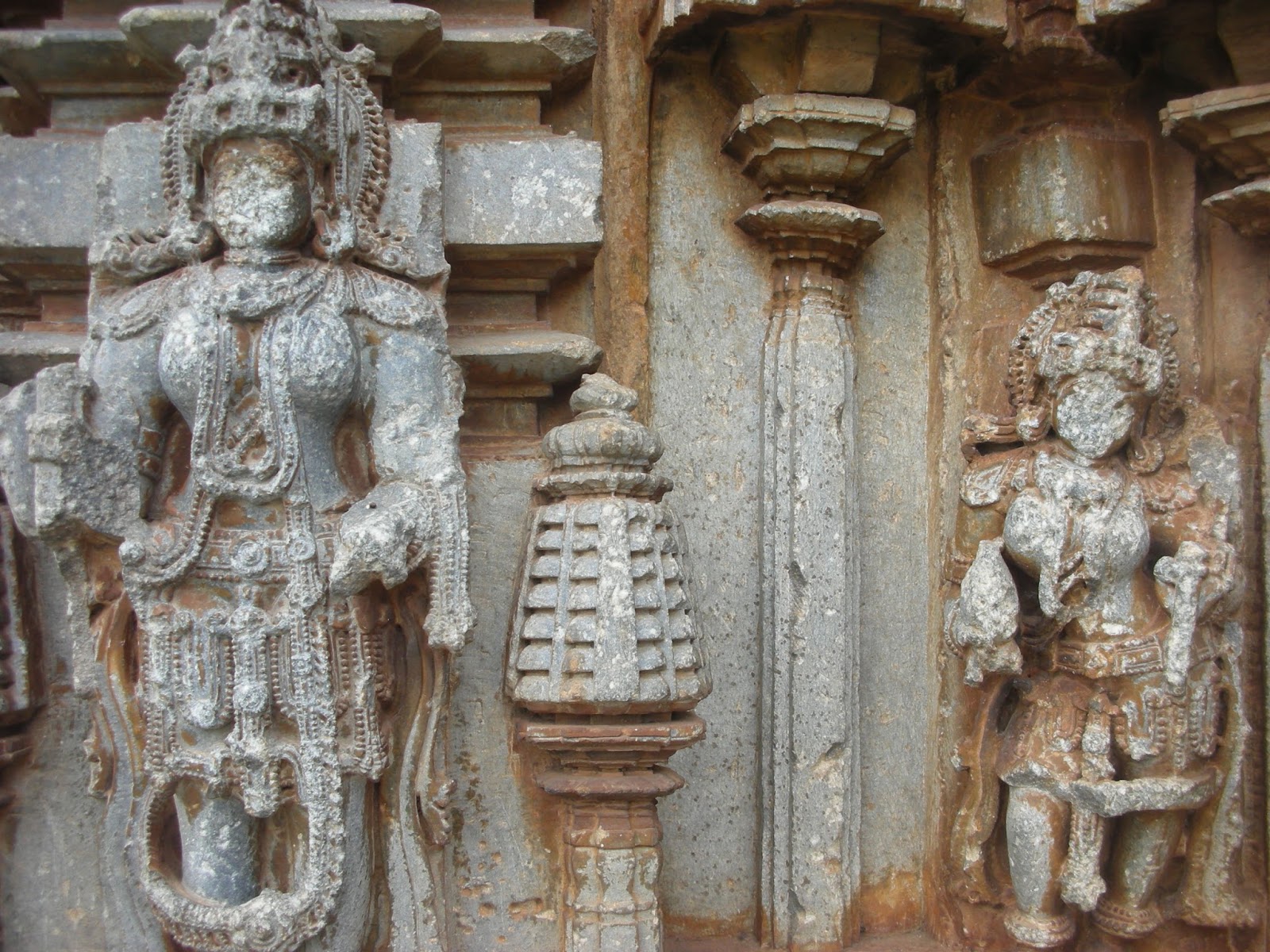
We observed all the idols in the outer walls were disfigured in Arasikere Shiva temple and Amrutheshwara temple. Especially their faces where chipped. So we enquired with the guides in both places. The answer baffled us. He said, some internal fights sir. Shiva followers hit Vishnu figures, Vishnu followers hit Shiva figurines!! But the same temple shows extraordinary harmony, by having Shiva Purana and Vishnu Purana sculpted. Besides, there are inscription stones lying there in temple complex showing Mahaveera, Shiva Linga also.
Answer in Amrutheshwara was that some cowherds without valuing idols had hit figurines. He himself was saying they have hit only faces, not Gopuras, Crowns etc.,
Why would cowherds chip Krishna’s face who is a Gopala himself?
When we prodded further, then he said, may be when Mohammadans invaded Halebid which was capital of Hoysalas, they had sent some army contingents to these temples to do their bit of service to Islam.

Islam is against idolatry. In all its holy scriptures it declares destruction as a holy job. All the Islamic kings took pride in becoming a ‘Ghazi’ a title given to one who destroys maximum idols & idol worshippers.

They themselves are proud of this act of barbarism and boast it. Even today they are destroying ancient UN protected temples in Syria and Iraq. Then why our guards & guides lie? Are they told to lie? If so why? Is it to appease Muslims? Or is it not to instigate anger & hatred amongst Hindus against Muslims?  In this overdo to please Muslims are we not hurting ourselves?

I asked who his Kuladeva is, for which he said, Shiva. I asked him if he would destruct Vishnu’s idol then. He retorted with shock – NO! Then who would do that? Which Hindu preacher or king or mutt would do that? In Hindus we have the culture of respecting others Gods. We call our God supreme but don’t destruct or hate others Gods. But still who amongst Hindus in Government is poisoning these innocent minds?

I thought only education department is guilty of India, but archeological department is even more guilty of its ancient past!! The custodian and presenter of India’s greatness itself is denigrating India’s peace loving nature of its natives.

Sociology & Science of Temple building:


All the dynasties, kings in India encouraged the temple building. Especially in Karnataka, dynasties made magnificent contributions in temple building. The Rashtrakutas sculpted the Ellora Kailasanatha temple. Then came the Chalukyas, then Hoysalas and finally Vijayanagara kingdom. The sculpture reached zenith of artistry in Hoysala times.

Sociology aspect: For an artist it takes a few months to sculpt a beautiful figurine in stone. That means in thousands of villages and towns, the people supported thousands of artisans for hundreds of years together to sculpt the entire temple. They fed them, sheltered them. The temples are generally named after the chieftains after whom it is dedicated. Like Amrutheshwara, Bhairalingeshwara etc.,

Imagine building a great temple, maintaining it for hundreds of years. It brings all people together. Most of the temples you will observe on the floor some board games, lines & dots. It indicates that it was a place of recreation. You will find more board games than your mobile games! You will see some fine dip in those floor stones. It is for making medicines by roller stones upon it. They are so much worn, that it sure are used for thousands of years. History in India says, that even when kings fought, they fought in the war field but never destructed each other’s temples. Temples were preserved. That’s why you see thousand year old temples but you don’t see palaces. Personal wealth always goes away. Community wealth stays long.
Take for example, the Bhoga Nandishwara temple near Bangalore. It is built around 8th cent CE. The temple complex is very very large. It has many mantaps (shop kinda structure). It means it was a place of congregation of large number of people for all these years. Even today village marriages, community functions, getting together happen in this temple.

Every day some religious function all 360 days a year for last 1000+ years!!!. What harmony! Can you imagine?

Temples have stood uniting people for yeomen years. Don’t listen to those guilty Indians if they say there is discrimination, there is hatred all around us. It is only with them.  

Scientific aspect: Then there are those guilty Indians who say there was no science in India. Science they say was rudimentary. You stand in front of these magnificent temples and say that. You cannot. It epitomizes, fine geometrical structures, absolute symmetry. That dome in Arasikere temple is very unique in all Hoysala temples. It is supported by 18 finely carved pillars with large open area in middle without a mid-pillar. How? The guide will show you how they used interlocking system to interlock tons weighing rocks. No patch work. Perfect locks withstanding all rock dome weight for a millennium!!!

I have asked in many Hoysala temples how they did fine lathe turned pillars. So many concentric circles, varying girth making it curvy; Did they have such heavy machines which could hold a rock of multiple tons and turn it around? Where are they now? Where is evidence? I have not got answers yet. 

We must understand that all science in ancient India was developed for social harmony. But modern science is science of destruction. Highways for accidents, bridges for collapsing, dams for submerging, cell phones for Pokemon Go!!!  


 Narasimha Mukha Ganesha
Bhoga Nandishwara Temple in Nandi Grama
 A beautifully crafted pillar in Nandishwara temple; All birds making up a design


 Gopura of Nandishwara temple
A beautiful pic in sky background
 This emblem is common in Odissi temples. How it came here? Were artisans going all over India? Man-riding-lion-riding-elephant. Man is greed, lion is power, elephant is prosperity


Harihareshwara temple: Epitome of harmony. The main deity is half Hari & half Hara. Who says Shaivaites & Vaishnavaites cut each other? 


Geometrical Symmetry: Symmetry at overall temple building level, then in Gopura. The symmetry at each angle in a finely crafted pillar is simply astounding. 


 The dome structure in Arasikere Shiva temple. The top concrete is also original 11th cent CE!!
 Inscription stones & Hero Stones. 
A typical hero stone (Veeragallu) shows veera marana in war, then he is being carried to swarga & then becoming Shiva sharana in Kailasa!!


Above: Faces chipped and disfigured by Mallik Kafur's army soldiers on instructions to disfigure as many figurines as possible in a short while before decamping. 

Right figures:  Ramayana, Mahabharata, Bhagavata are all finely crafted scene by scene in tablets. Imagination of artists to represent, river crossing, falling to donkey's feet not to shout are all extraordinary. 


You find lot of recreational board games in every temple floor. This indicates their social gathering & gaming in temples for time pass
Fine lathe turned pillars. Polish is still shining. You wont find this technology in Vijayanagar times. So the technology died between those 2 periods? If so why? how? Are we declining in science & technology era by era? 


The school I studied primary in Honnali. It was always green surrounding and it has maintained till date.


Monday, 25 August 2014

I am not a Communist; I am a Socialist

Who cares? But anyway here I am.

Some of the articles I have written made many believe I’m a communist. They did brand me a communist. Someone commented on me as a bleeding heart communist in reply to a detailed comment on an article in the social media:
http://www.thenewsminute.com/news_sections/1007#at_pco=cfd-1.0&at_ab=per-2&at_pos=7&at_tot=15&at_si=53f9d20f52059760
 
So I thought let me clarify what I am. I’m a proud Indian. I’m a proud Hindu. I’m a proud Kannadiga. I’m a proud Madhwa Brahmin. I’m a householder. I’m a nationalist. My writings and thoughts are deeply sociology based. Hence I am a socialist.

I’m proud of who I am and all characters stated above. I can defend to a great extent all of it & why I should be proud of it.

All oppositions I do and write also reflects these characters only. Be it opposition to large dams, opposition to industries for personal wealth, opposition to personal transport, opposition to faith conversion through violent, bribery means, opposition to propaganda based education, opposition to capitalism, large conglomerates, Loan based economy. Etc.,

My support for many things also stem from my upbringing through who I’m stated above. Like for example, It is Hindu culture to worship nature & protect it through strong communities who are custodians of nature for many millennia; It is Kannada culture to fight inequality; It is Madhwa Brahmin culture to embrace debate culture and oppose propaganda based education.

What is socialist? Why am I a socialist? We’ll delve in this article. A socialist is not communist. A communist claims to be a socialist.

Do I oppose communism? Yes I do. Clearly. Let’s first see what it is.

What is communism?

It is a failed theory in Russia as well as failing theory in China. Some argue what is followed in China & post Lenin Russia is not communism at all. But the fact is, it failed first & hence it went corrupt. In any case it is rather new theory and is yet to prove itself if at all it gets a chance. My argument is it has inherent problems to succeed. I’m not an expert though in this subject. Not well studied but I had to write as I wanted to veer away my branding.

Inherent problems in communism:

Communism is completely state driven. State drives everything. State determines what is good for the society and imposes upon it. There is little individual rights. Think tank is supposed to be centralized and determines what is good for the state. Communism believes society is not mature, it cannot govern itself. In the name of equality, State owns everything. Individual owns nothing. Every individual works for the state. He needs to work what is determined and directed by the state. So an individual, who wants to explore inner self, spirituality, explore the world, nature’s creation, who created nature etc., will not be supported by the state nor will allow citizens to support him.

Religion is defunct under communism. In fact, Karl Marx says, Religion is like Opium. This will get them into trance and forget the worldly life.

Communism, I believe developed in a context of the Christianity’s domination of state in the European region. So communism only responds to Christianity as Opium.

Christianity dominated European state post the decline of the Roman Empire. Roman Empire declined due to its excessive emperor-slave divide. And raising slave unrest.

Later rulers across Europe conveniently used Christianity as a tool to suppress the salves rising against the state. The rulers through the church preached them to believe in God and forget misery.

For centuries this authoritarian rule bread inherent unrest. As a result, people protested against authoritarian church. Renaissance came. Science & inventions, exploration came. Protestants came. Industrialization happened. Industrialization ushered in new found wealth by excessive exploitation of the earthly resources. Industrialization created wealth in few hands increasing the slavery through organized labor. So it created again big inequality.

Communism rose through Marxism. It said religion is opium. Religion is making laborers compromise on their rights. Marx said all have equal rights and have to claim it. So it devised a state driven equality based Industrialization. So everything that laborer produces belongs to state. And then state will distribute the wealth equally amongst all.

So it created a powerful state. It created “Concentration of wealth for the purpose of Distribution”. Power corrupted the people at the top. People at the bottom became complacent. Their freedom suppressed. Productivity plummeted. State became more authoritarian to push people to produce more. Unrest followed & overthrew the authoritarian communism.

So in China today, there is much authoritarian rule. There is much unrest building up. Tomorrow it might explode. Usually when an internal unrest builds up, authority looks for external aggression to raise patriotism and sacrifice by its citizens. So there is an imminent threat of aggression over India. It might happen in a decade or in few decades. But that threat is imminent and looming large.

Indian politicians are fools to not consider it and be prepared.

What is Socialist? Why am I a Socialist?

Socialist is someone who sees strength in society, unity, and people. Socialist believes empowering society. Society should build up state. It should be bottom up approach. Society in every region should be independent, self-sufficient. It should govern itself through society building and respecting it. It should contribute to national wealth. It should contribute to state machinery like – administration, legislation, police, military, and economy.

Especially economy. Society should determine its own strength, region’s wealth, form cooperative societies, extract earth’s wealth in sustainable manner and contribute to state’s exchequer. Develop entrepreneurial attitude and support it, harness it and control it within exploitation limits.

Yes it is all possible. For that we have to read Mahabharatha, Kautilya’s arthashastra and various other our own ancient texts. On local economy & its strengths, how to harness and how it is better than global economy I had written 2 blogs earlier posted here.

Only in military & external affairs, the decision should be top down. State should determine what is right. For security purpose industrialization & transportation should be planned. Those plans require sacrifices from regions and societies. State should reason with the locals and rehabilitate first before opening up their factories, highways and railways.

Education

Most importantly society should educate children. State should very minimally intervene in education. Local society should build education curriculum & infrastructure. We have to evolve ‘Gurukula’ system to modern day needs. Pass, fail, exam, certification should all come beyond 10th standard. Let there be universities like Nalanda, Takshashila for higher education to explore the world with passion for learning. Not education through propaganda & factories like colleges producing certificates without knowledge, exploration, questioning, analytics.

But before that in primary education, we should educate children on sociology, community strength, regional strength, regional diversity, importance of keeping diversity towards strengthening unity, regional heroes, regional culture, weather, contours, regional wildlife, flora-fauna, its specialties, regional grains, vegetables, its importance for health. There is whole lot in each region in India. We don’t even know our own lakes, who built them, what rivers flow in our taluk, what grains we produce, what birds thrive here, who are our heroes? Why are they regional heroes? Education in local language, its strengths, beauty, diversity, dialects are important. Let the child open up its brain to innumerable variety around its vista.

For my son, 4th standard exam question was: Where was Jesus born? I had asked my son to write Jerusalem for anything to do with Christianity, Judaism, Islam. So he got Zero. Our kids don’t know who is Purnaiah, Madakari Nayaka, DVG, Visweshwaraya. But those are unimportant for Indian educationists.
5th standard social studies text book says Chicago is the largest Cow Slaughter Industrial hub. And that must be mugged up for important questions in the summative exams.

How important is all this? What patriotism are we building in them? Why are we so obsessed with global culture? International languages? People ask why should we learn Kannada at all. People chose Spanish/Japanese for kid’s third language. Why? Because it gives job opportunities. 

We are so afraid of jobs. Everything we learn has to be to earn living. Stomach filling is the only aim in life. Once we get a job, nothing else is important. We stop reading, studying, knowing, teaching, wondering about the world, construct of the world, societies etc.,.

Our current education is to soften our pride, by pass, ignore teaching children on the richness of local culture. Once they realize our education did not give a shit to our culture, tradition, scriptures, heroes, they grow up to become indifferent to all of it. They become indifferent to protect their heritage. Once they become tomorrow’s educationists, administrators, politicians only through mugged up knowledge and certifications, they look at money & their personal living as ultimate goal. Society concept is broken. Individualism becomes important. They will be ready to sell anything for money & living. That’s the culture we are cultivating through our current education.

We also studied like that only. That’s why we don’t know what DVG wrote, what Bendre wrote, what is Kautilya’s arthashastra, Vidura Neethi? We are ready to sell our society, nature, wealth at the altar of foreign traders, companies & countries.

Our Current Jobs

One generation back, take any of your parents, uncles, aunts etc., They used to work for something connected to our society. Either in Government offices, teaching, public sector, insurance, bank, farming, trade etc., They knew their customer, their vendor. They knew exactly why they are working, who gets benefited and how.

Today, take for example export oriented industries, the biggest employment industries. We produce largest software services & sanitary napkins. Who uses it? The world uses it. In India it is least used. We don’t produce for ourselves what is necessary. Or we don’t use what we produce. We have created a huge divide between India and Bharath. India is producing big things for all countries and taking cash. The middleclass who get that cash, keep it for personal luxury – cars, bikes, houses, multiplexes etc.,

Our luxuries are costing earthly exploitation, forest destruction, and river drying forcing people to migrate to urban slums. Do we care? We have become indifferent. We lost our connect with our society.

For getting a job in these personal money earning industries do we use the education we did? For example, to become a software engineer I cracked Shakuntala Devi maths puzzles. That’s it. Not engineering studies. After that since last 15 years I have never used all that engineering subjects I studied nor primary school subjects. I have used some basic arithmetic, basic analytical, logical skills. Apart from that it is majorly commonsense that is utilized. English language conversation I picked up after joining job.

Lets say, if you were from a Gurukula system studied upto 10th standard, got around some basic maths, English language, and you cracked the entrance test for your job and interview as per their current evaluation and requirement, would you not have been as effective today?

Similarly in textile industries, the largest employment generation industry, none of what they studied in school is used. So why study Global culture in primary education?

Isn’t Our Society important? Should we not study society, our life style, life style effect on society? Individualism is detrimental for the country. But is somebody listening?

With all this writing still, I live like an individualist, typical urban middleclass, with an indifferent lifestyle. But I do think at least & I write. May be it will lead me somewhere or make others think and change their stance. But thinking is important. It will change things ultimately.  

So anyway if you have reached till here, I hope you know by now, what is socialist and why am I a socialist.

Monday, 4 August 2014

“Your God is My God” Vs “My God is Your God”

This is an article on the faith conversion in society & its effects. The title though is pretty tricky. But that’s the way it is.

People generally ask, what is wrong in faith conversion? It is individual preference. If they are influenced by someone to convert their faith, so be it. The answer is simple yes. But there is more to it. What was the influencing factor? How it impacts the individual? What is its impact on self pride, self esteem. How it impacts the society? How it impacts ecology? How it impacts sustenance of life? How it creates class divide, Separatism. How it creates imperialism, domination. We’ll try to understand step by step.

First, by understanding the concept of God.

Did ‘Man create God’ or ‘God Create Man’?
This is a standard question that atheists ask. Atheists’ argument is, there are millions of gods on earth. All of them created by Man. Man gave them names. Man gave them form. Man characterized god. So God is an imagination of Man.
But who created Man? Who created trees? Who created vegetables? Animals? Water? Earthly elements? All these are working in such beautiful harmony in nature. Who created nature? Why this nature doesn’t exist on Mars? Who created Earth? Can Earth be by itself? Does it need Sun? Why is Moon required? Is Mars required? Why is all this created?
 
I believe there must be a God who created all this. He created all this to sustain each other. His creation- sustenance-destruction and this cycle continuation is a beautiful music. He created a brainy man to explore the music, appreciate it & entice Man to reach God. But can Man reach God? Is God in a form that Man can recognize? Man cannot even understand how elephants talk? How Whales communicate? He doesn’t even know how Honey bee produces Honey? How can he reach God? He cannot even hear beyond Sound wavelength, he cannot even see beyond light’s wavelength.  

So I think, since Man cannot reach God, God reached Man. God took several forms and appeared before Man. So that, Man can touch him, feel him, hear him, and understand him. That’s where the multiplicity of God came by. Man gave him form, character etc., So ultimately Man imagined God within his limited forms of imagination.

Your God is My God
So, different communities living across the world created God within their limits of imagination. This created differences in their culture, tradition, worship, power etc., This created ego clashes between communities. The ego clashes turned violent into fights & wars.

In India, though the ethnic flare was contained to a large extent. That’s why you see such a large canvas of culture and tradition coexisting here. How? Elsewhere in Europe, America, Asia etc., you will see uniformity & much less diversity. How?

The Gurus, Rishis, Munis who were intellectuals of ancient India brought in this concept of ‘Your God is My God’. That means I see in your god my god. That requires lot of guts. It requires one to submit his ego. It requires him to quell the insecurity that the other guy might undermine my God and impose his culture, his rituals upon me. Once you say, I see my god in your god, then the other person becomes comfortable to receive him. He will even reciprocate that feeling. That sets in understanding each other’s culture. That sets in understanding why a certain community consider a certain God as their God.

That’s why worshipping of Durga, Kali, Shakthi, Sharada, in different forms by different communities seeing their own deities in her. Some see her as Lakshmi. Some see Parvathi in her. Some see Saraswathi in her.

Panduranga Vittala is a very famous god in Pandarapura Region. There are great many stories of the knowledgeable person Vittobha in that region. People paid great respect to him for his knowledge and miracles he did. The respect became reverence and people worshipped him as God & Vitthobha became Panduranga Vittala. Krishna followers exclaimed that he must be Krishna only. Vittobha was a householder & his deeds and life was compared to that of Krishna. Differences and Similarities were all submerged in the great fervor of Bhakti towards the lord by both communities. Great many songs, tales emerged from this congruence.

Similarly, the story of Venkateshwara in the Thirumala hills region.
These are not from the ancient Puranas. They are called Kaliyuga Devaru.   
Similarly Mallikarjuna, Manjunatha, Padmanabha, Mukhyaprana… there are millions of gods accommodated and coming up even today, every day in this land of Bharatha Bhoomi.

How else would you explain the following few modern day instances:

1.       A Brahmin Poojari doing daily Pooja to a Muslim Sufi Saint - Shirdi Sai Baba with the save fervor he does Pooja to SriRama? Sai Baba has great following amongst all communities cutting across religions. He said “Sabka Malik Ek”.

2.       We sing Santha Shishunala Shareepha’s song with the same dedication as we do Shiva Sharanara Vachanas? Shareepha said “Allah & Allama are all same with different names”

3.       Gandhiji adopted following hymns in his prayer meetings and we sing that with same fervor even today:
Raghupathi Raghava Raja Ram, Pathitha Pavana Seetha Ram
Eeshwara, Allah Thero Nam, Sabko Sanmathi De Bhagwan  

4.       There is a temple in the middle of weekly market in Chitradurga of a goddess deemed powerful by both Christians and Hindus. They worship her in their respective ways.

5.       Buddha is considered as an incarnation of Vishnu by certain section of our society. Many scholars I know vehemently argue in this theory. And there are many who argue against too.

India’s hues are beautiful & vivid. Our forefathers have passed on this culture of seeing ‘Your God is My God’, generations after generations. Lets assimilate all gods in our society.  Let God not divide our society but bind it.

My God is Your God
Buddhism, Christianity & Islam recognize followers only by the God they follow. God is their primary agenda. Recognition of their religion is by the God the people worship. The society, its culture, its language, its tradition, its God, its rituals are secondary. Their inflexible religious texts, are guiding principles for them. And their guiding principles emanated by one Man who became God by his greatness.

These religions’ main interaction with the multi-cultural society is through Proselytization. These religions do not appreciate Polytheism (multiple gods). These religions propagate Monotheism. Monotheism is the theory of ‘there is only one God’. And that’s why ‘My God is Your God’. They tell the gullible to shun his God and adopt the new God that they preach. They force him to see God in their God only and not in any other form or name.  

Proselytization is faith conversion process. These religions give very high importance to Proselytization. It is their salvation process. It is through different forms – evangelizing, propaganda, service, bribe, crusade, and violence etc., All forms are followed in the history. Depending upon the prevalent system at that time in that region they follow different forms. For example in India, currently the country is calm and civilized. So through propaganda, service, bribe, love, the conversion process is prevalent here, today. In African countries today, crusade by the Islamists is happening. In the medieval periods in India, violence was followed for the Proselytization. Christianity crusaded on Jews on way to Jerusalem in the medieval period. In Burma and Srilanka Buddhism is prominent today. Rohinga Muslims in Burma are driven out today. Srilankans just now ended a bloody war of killing all rebel Hindus & Christians. Burma & Srilankan example however cannot be related to the religion. Because it is a military Junta & a democratically elected government waging war on armed rebellion respectively. But I would argue, the root of these wars is religion.

The effect of forcing one to accept a different God than he was following earlier is long and harsh. It creates a scar on him. The Church/Mosque/Monastery will be the place of worship. He cannot take his God there. He cannot create his own temple where he can put his previous God with the new God. Then he will not be considered as part of their religion. He will be separated as Hindu. These create separatism in the society. Assimilation of other Gods and culture is strictly prohibited in their religion.

The converted person will face insult of his tradition, culture, language etc. He will have to shun all of it. He will have to shun his pride & self-esteem. He has to subjugate completely to one inflexible authority. The authority will develop Imperialism. The freedom of thought and expression will be suppressed.

Religion should preach “Way of Life”
Let there be God. Different Gods. Different Names. Different forms. But let there be understanding of differences and appreciation. Not killing, undermining, and insulting the differences.

Let the religion preach essentials to bring down the class differences. Let it preach to bring down economic divide. Let it bring social impact to make sustainable Urban & Rural living.  Let it preach the society that diversity is the essence of life. It is needed to maintain ecology. It is needed to maintain dignity. Let it preach us how to live in harmony with each other. Let it preach us how to live in harmony with nature. Let it preach to not only respect nature but worship nature. Not to cut the cow (nature) but to milk the cow. Let it preach us ‘How to Live Life Peacefully and Welcome Diversity’.

Let the Upper Strata of Society who are Intellectuals, like Saints, Pontiffs, Mullahs, Pastors, debate on the sociology and arrive at exclusive, yet binding, interdependent culture amongst their societies. Let them not shut their door of open debate with other religious heads.

Let the Lower Strata of Society like land tillers, factory workers, urban slum dwellers, develop unity, and bring out their own mutts, pontiffs. Let them fight for their rights, build strength by unity. Let them not be lured by individual instant gratification and benefits. And yes, despite so many saints and Guroos, there is dearth of Mutts and Pontiffs with true social purpose in India.

Let the Middle Strata of Society, like us try to understand society as a whole and not be lost in self-indulgent, indifferent life style. Let us empathize with lower strata of our society. Let us push our intellectuals to develop debate culture.

 Let the religion develop Sociology, Social Life.
Let the religion make God’s name& form immaterial.

Saturday, 12 July 2014

Context of Some World Religions

In Kannada there is a saying ಮನೆಯೇ ಮೊದಲ ಪಾಠಶಾಲೆ, means, Home is the first school. The education we get at home is immensely impactful in our life. And religion plays a major part in our home environment. Most people in the world are religious. In India majority of the population follow some religion. Very few question god’s existence. And yes religion is about god but definitely not only about god. So the education through religion is essential in man making mission.

Religion is a very vast subject and one can have only limited knowledge there. And writing about it is a bit of arrogance only. So I apologize for my arrogance. But I have to write what I know of. And being a proud Hindu, my writing will have that flavor or view.

Prakruthi in Religion


Gayathri manthra is one of the most potent manthra in Vedas. Every child who starts his intellectual journey is taught Gayathri Manthra in Hinduism. Gayathri is the embodiment of the entire Prakruthi. Vedas call upon the gods of elements as most potent gods. Every elemental God like Agni, Vayu, Varuna, Indra, Rudra, Vishnu, etc., are revered as the most powerful gods in Vedas.

Later Upanishads and Puranas came upon to define the concept of “Supreme God”, probably initiating Shaivaites, Vaishnavaites and other sects, where one God is Supreme. Like for Shaivaites, Shiva is the supreme god.

Hinduism originated with the exploration of the worldly elements and wondering of its strength. Pancha Bhoothagalu – Land, Air, Water, Sky & Agni form the basics of exploration. It is the beginning. Each of them have so much to study and wonder about its strength. That’s how the study of Khagola (Astrology), Ayurveda (Health Science), Yoga, Pranayama etc., started and is continuing. The nature is all powerful and meets all needs of man, animals and other forms. But man is the only enemy for man & other forms. Man instead of exploring the strengths of the nature in harmony with the nature, is involved in exploiting it in pursuit of something called luxury which is elusive.

Sandhyavandana is a daily ritual stipulated for all Hindus. In that we pay reverence to all the elements of the nature from earth to sun & beyond.

The nature worshipping extended beyond the basic elements in our civilization. For example, in Mahabharatha, Krishna lifted the Govardhana Giri, indicating, it is the life giver and saver for the Gokula community. Thus, very diversified, vibrant, beautiful culture & tradition developed through worshipping various forms of nature like, Mountains, Rivers, Forests, Trees, and different animals in different forms. For example fishing communities eat & trade fish. The richness they have is due to fish. Everything they can get for their life depends upon fish. So Fish becomes their God.

The religion encourages the communities to protect their richness, thrive their generations upon the nature’s peculiar gift to that community in that region. For many millennia’s, they have extracted the wealth without destroying it, but harnessing it. They have lived in harmony with it. Naturally they worship it as God. That’s how we got crores of Gods in India.

Sociology in Religion


Most of all the other religions in the world originated in that day’s sociological context. It is the sociological context which is the origin of many of these religions rather than a holistic universal view to begin with.

Man is a social animal. He needs society to live in. An enlightened man from the society emerges and questions the order. He questions the authority of that present day ruling system or living system & revolts against it. He creates followers. And then it is the followers who create a separate religion under him or his preaching.

Gauthama Buddha originated Buddhism. When he encountered poverty and despair outside his palace, the reality of the world hit him hard. He went for penance and was enlightened under the Bodhi Vriksha. He found that the “Desire is the cause of misery”. He called upon renunciation to attain moksha (Salvation). In that social context, the sociological class divide compelled him to run away and find answer to the cause.

Jainism started mainly in the social context of propagating nonviolence. Their doctrine is “Ahimso paramo dharma” which means the Nonviolence is the righteous path. Mahavira is one of the most revered 24 thirthanakara in Jainism.

Jesus is the author of the Christianity. The Judaism precedes the Christianity. And Jesus is one of their prophets. The social divide between the kings and the subjects were stark in those days. The prophets of Judaism tried organizing the oppressed slaves. The famous journey to the Promised Land started. The infighting amongst the subjects broke the peace. Then came the Ten Commandments to discipline them. The commandments being very rigid, made every man a sinner. And lord was not supposed to be forgiver for the sinners. And people remained sinner. In that social context, there came the great prophet, Jesus Christ to release the sin of the sinner. His simple message touched everyone. He said the “Lord is a forgiver”. His social message was simple and crisp. It was very appealing. The Bible is a holy book of Christians mainly from his preaching.

Prophet Mohammad is the messenger of God in Islam. The sociological context in that present day was marred with tribal conflicts. The conflicts used to conflagrate to bloody wars causing lot of loss of lives. His doctrine was that of “Universal Brotherhood”. He struggled to bring all humanity to accept one God calling him – Allah, The Great. Different tribes worshipping different forms and idols was discouraged by him and called upon all of them to accept and worship the formless God, Allah the Great. The peaceful message in the Holy Book of Quran of Islam helped coercing the warring factions to come under the universal brother hood of Islam. The Holy Quran is the book of his preaching. The followers of Islam are carrying out his example of Jihad on people to adopt Islam through various means which are not necessarily peaceful.

Sociology in Hinduism


“Vasudhaiva Kutumbakam” is a popular phrase in Hinduism signifying the entire world is one family. The Ramayana and Mahabharatha are epic stories depicting throughout the sociological conflicts between different styles of living clans. While Rama is Maryada Purushothama upholding the rules & abiding by it very strictly at the expense of personal agony, Krishna is at ease while breaking the rules in vogue to keep up the “Dharma”. So what is Dharma?

Dharma is simply Manava Dharma. That is to be compassionate towards another human being. “ದಯವೇ ಧರ್ಮದ ಮೂಲವಯ್ಯ” is a famous saying from the 12th century social reformer Basavanna who started the Lingayat movement in Karnataka.

Every human being has personal liberty. But personal liberty often comes in conflict with the social well-being. Then the social well-being takes importance. It should take importance. That is what Dharma is. And through story telling technique, the righteous path was being taught in the ancient Gurukula system. The Ramayana & Mahabharatha are full of stories of such conflicts and underlining what is Dharma, Nyaya & Neethi.  

Because, through stories, you get into the lives of both the affected and the affecting people. So the listener will be able to judge the righteousness throughout the story.

Today's Sociology Study

But unfortunately today, in the schools and universities, the Subject of Sociology is very bland and boring. It is restricted to only in BA. Other important degrees like, MBA, BE etc., are about Business management, technology. For whom? For self. Not for people. Student coming out from BE, MBA is made to think for himself only and not for people at all. But shouldnt the masters degree student study both benefits and impact of technology on society as a whole?

Even sociology is deduced to numbers. Through numbers you really cannot understand the people’s lives and resonate. Policy decisions are based on sociological assessment. But sociological assessment in today’s parlance is only numbers & not people’s lives. Dharma is taken back seat. In fact in today’s milieu of politics Dharma is not Manava Dharma, instead it indicates “which god’s follower”? And hence Dharma is wrongly construed as religion.

Isn’t it wrong?

In the next blog we’ll discuss “The Death of Debate Culture” through religions.